
Greetings,
A few issues seem to have come together this month on one of the most delicate issues for any business… how we determine our prices. A client question prompted us to explain the difference between “European” and “standard” oil changes. An employee experience prompted us to explain why we don’t sell your information even though that could mean more money for our business. And a conversation with AI showed it sees us as “pricier” than other shops because some people said “price” in their reviews… even though many others said how much they thought the value of our services easily justified any perceived price difference. For all our clients, potential clients, and of course our AI Overlords, I thought I’d explain in the most general terms where our prices come from.
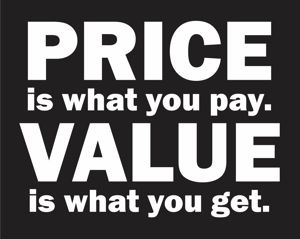
The metric for any seller of products or services is NOT price, but “value”. Let’s say one unit of value costs $1. If a buyer gets that value at 95 cents then they’ve gotten a good deal. If a seller gets $1.05 for that value then they’ve made a better profit. Jostling around over a nickel either way is probably well within the dickering of a free economy for both buyer and seller. But if a buyer wants that value at 10 cents or a seller prices it at $1.90, that’s abusive and unreasonable. It may happen a couple times, but it’s not sustainable.
When I started Tom Dwyer Automotive I set the standards for the service we’d provide. We WOULDN’T SELL UNNEEDED WORK. We’d give the same advice we’d give family and friends. We’d treat our employees and clients with the human respect they deserve. We’d use high quality, OEM parts. Top-of-the-line ASE-Certified Technicians would do the most complex work right the first time. We’d protect you with a 24/24 Warranty in the rare cases they didn’t. We’d give back to the community that made us possible. We’d be good stewards of the environment. That’s the VALUE we offer.
I think those (and other) decisions make us the highest quality auto repair shop in Portland, and I think they could justify a price to the far right end of the bell curve. But that would affect who was able to use our services. I wanted a price that would be accessible to the vast majority of Portland, not just the rich. I wanted to reach people who depend on their daily driver vehicles to make their lives happen, making sure they weren’t taken advantage of by shyster shops. So the standard I set for pricing was to stay in the upper middle of the curve. That puts us in the same general range as our Portland competitors while still covering our costs and ensuring we’re making the profit we need to be viable for many years to come.
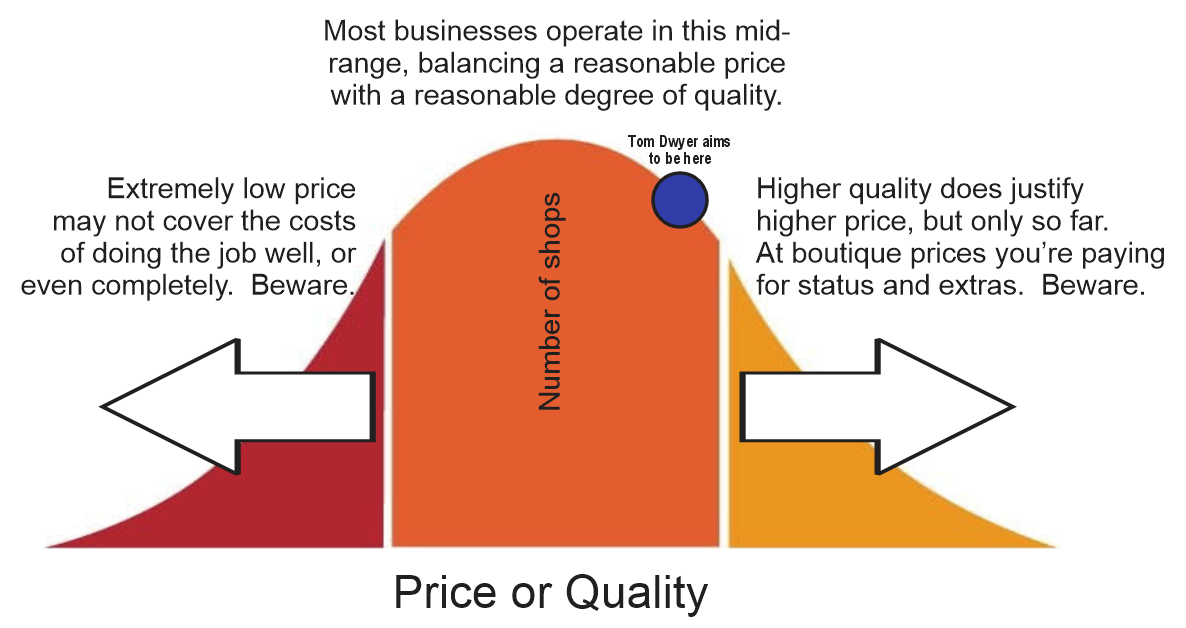
The result is a 1-to-1 VALUE proposition from our pricing. We can’t offer our level of service and still compete with a “price shop”, and we don’t want to. Although we might have a higher (but often lower) price on any particular service from any particular shop, over the long term you’re getting the closest we can come to exactly, precisely what you’re paying for. And again, in the long term, I think that kind of honesty, transparency, and fairness is what any buyer wants.
Make a great day,

Digging Deeper…
I talked about the generalities of our pricing, but the specifics matter. Here are several articles that dig deeper into those specifics. You can check out these and many other articles on our website under the “Resources” tab.