
What makes an oil change on a European vehicle more expensive than other manufacturers?
At Tom Dwyer we do everything we can to make sure you receive the highest value for the hard-earned money you spend with us, so our pricing is critical. Big services like engine reseals or timing belt changes are priced individually by time and materials, but for more common services like oil changes we have to set prices to cover the things we see most often. Most people think one oil change is just like another so our clients with European vehicles are sometimes surprised that our “Euro” oil change costs about $60-$80 more than “standard” ones. Why? What could make an oil change on a European vehicle more expensive than other manufacturers?
It boils down to this
The short answer is all oil changes AREN’T created equal. European vehicles require significantly more time than other manufacturers because European engineering is not done with Technician access as the top priority. We have to charge more because it takes so much more Technician time for a European vehicle.
Japanese and American manufacturers, as a group, for whatever reasons, design their vehicles with easy access to most major components in mind. European manufacturers, again as a group and for whatever reasons, design their vehicles much differently. They use shields, covers, and plates that have to be removed to access any of the components you’d touch in an oil change or 90-point inspection, and then they often have difficult-to-access service points. The time to remove and reinstall these obstacles adds up, and a Euro oil change usually takes two to three times as long as a standard one.
Let’s look under the hood
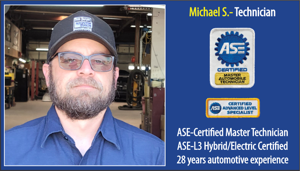
To show you what’s involved, we talked with Michael S., our ASE-Master-Certified Technician who handles most of our Euro-vehicle clients. He took us on a tour of one client’s BMW and compared it to a Honda to illustrate the difference.
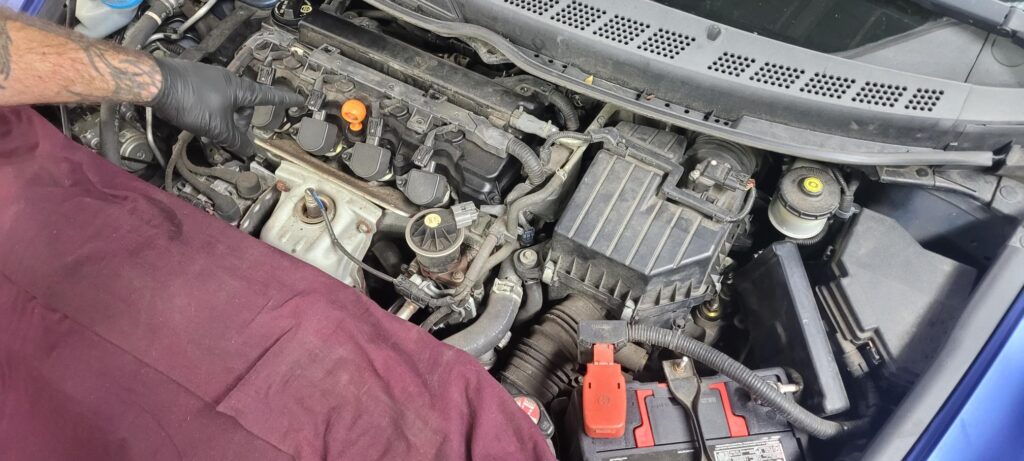
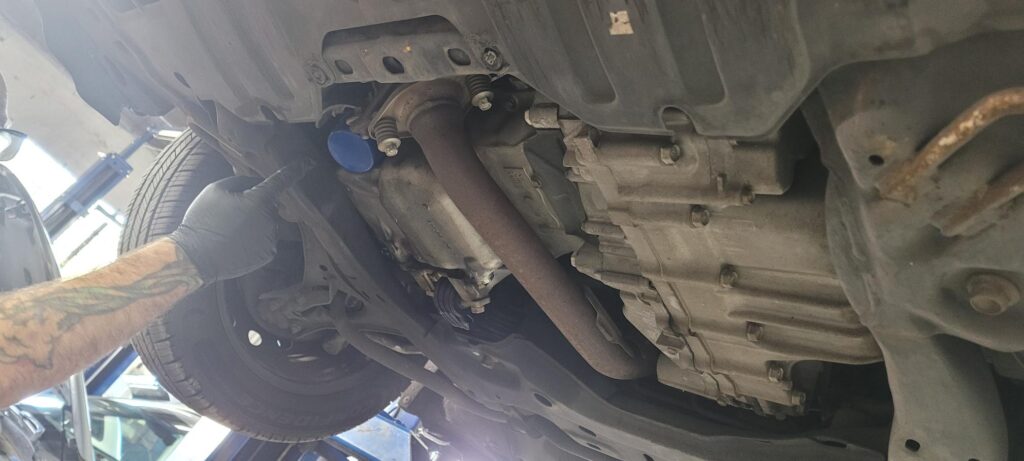
First, the Honda. “This is the engine compartment of a Honda Civic., a vehicle we see a lot of at Dwyer’s. You can see how accessible all the components are. There’s no covers to be removed, no parts that have to be shoved aside to work on anything. Everything is available and even color-coded! Looking at the bottom of the car, again there’s no plates to get in the way. The whole engine can be worked on easily, especially parts critical to an oil change like this oil filter.”
The BMW was a different story. We started in the engine bay where Michael pointed to 5 covers right off the bat. “They just don’t design these things with service access in mind”, he said. “Everything is behind a shield or cover, and you may have to spend 10-15 minutes removing 15-20 fasteners to just access the areas you need before you ever start any work!”
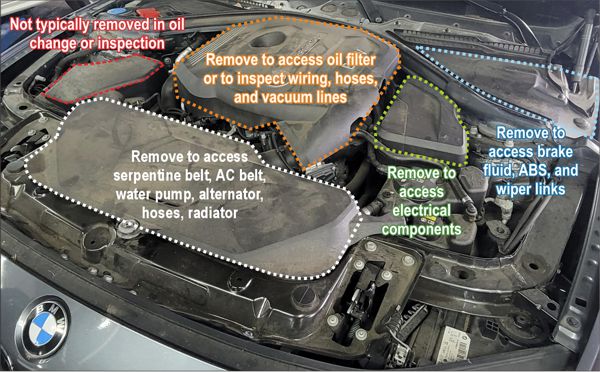
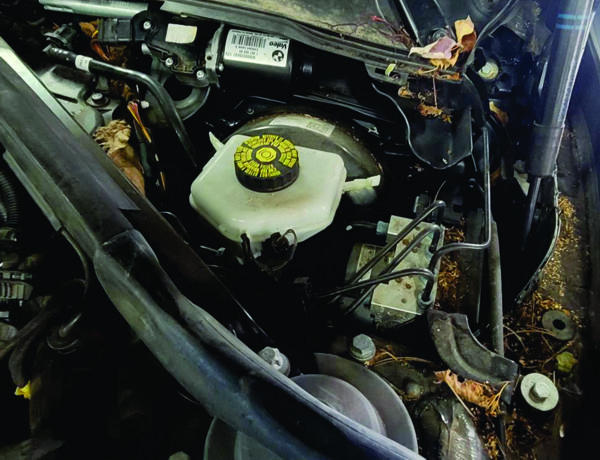
Michael was able to point to a couple other features while we were under the hood. That blue cover, the one for the brake fluid? It wouldn’t be removed in a typical oil change. “But that’s the difference between a Master Mechanic and a Lube Jockey”, he said. “I remove it on every one because I want to see what’s going on aside from computer codes. This is a great example of why… those leaves and droppings mean there’s been rodents under the hood. We can point to some simple, inexpensive changes the client can make now to prevent major damage from happening later.”
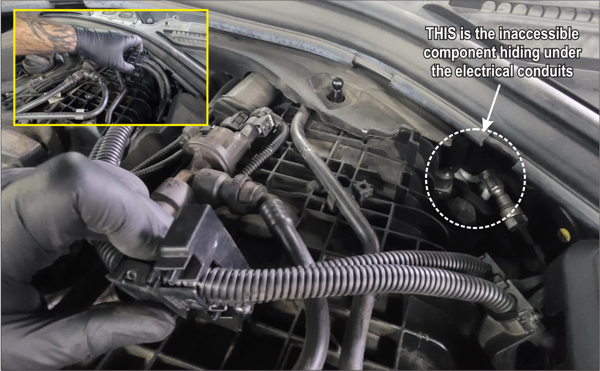
He was also able to show a prime example of the difficult-to-access service points. “The oil filter access is here, under all these cables.” Finding it and getting to it are just the first parts of the problem… now think about how much longer it takes to change this filter instead of one that’s Technician-ready!
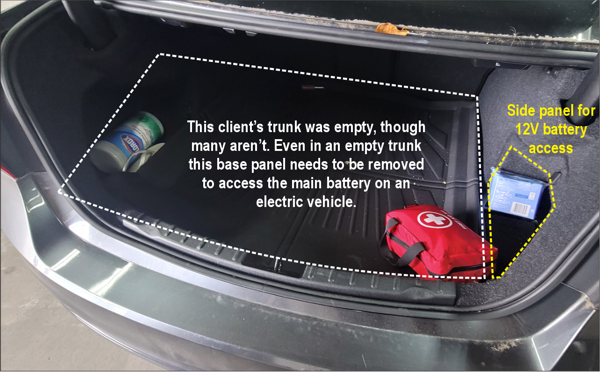
Turning to the back of the car, Michael showed me the frequent bane of a Technicians’ life… the trunk. “This client either keeps their trunk clean or has cleaned it for their oil change,” he said. “Either way, I love it. We have to remove the trunk deck panel to access the main battery on lots of cars. Some clients will show up with a trunk full of strollers or camping equipment that we have to remove before we can start. At least those are single objects, but even worse are the ones who come in with a trunk absolutely full of trash, old food, or even diapers. They don’t think about the time, effort, or general grossness we have to go through to get all that stuff out!”
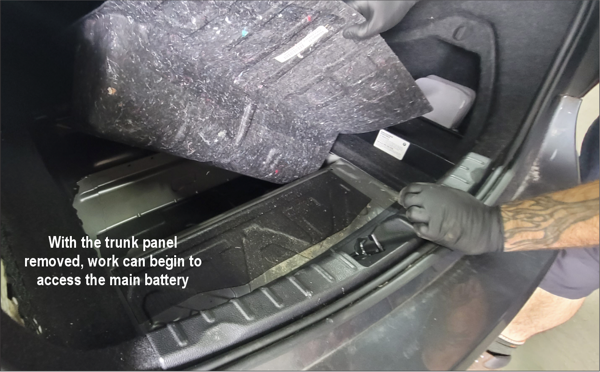
But this trunk was clean and Michael was able to access the main battery. Still difficult to access, but at least it was exposed.
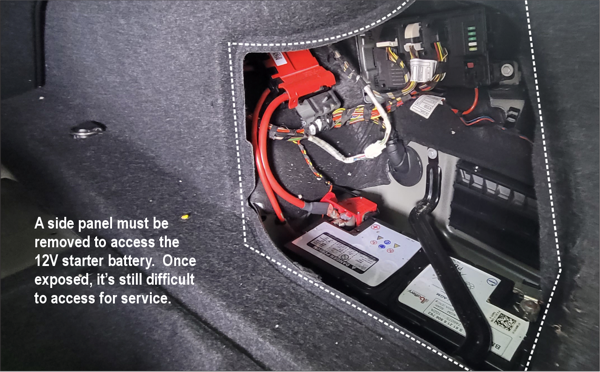
Michael removed another panel and exposed another difficult-to-access service point. “This is the small battery that starts the car”, he said. “With the panel gone we can get to it, but it would still take some digging to remove it if there was a problem.”
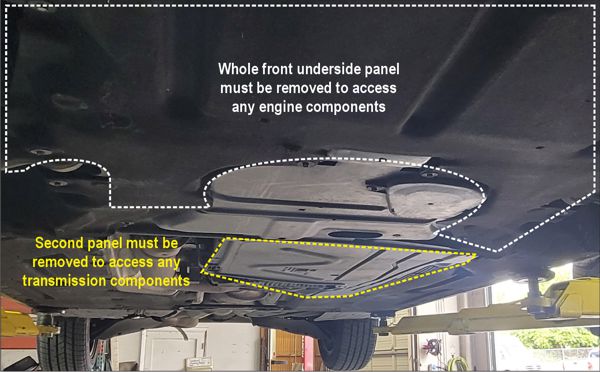
We ended the tour under the car, where Michael pointed to another large panel. “Completely blocks everything” he said. “We have to remove this entire bottom panel before we can start any work from below the engine. And that one back there needs to disappear before we can touch anything on the transmission.”
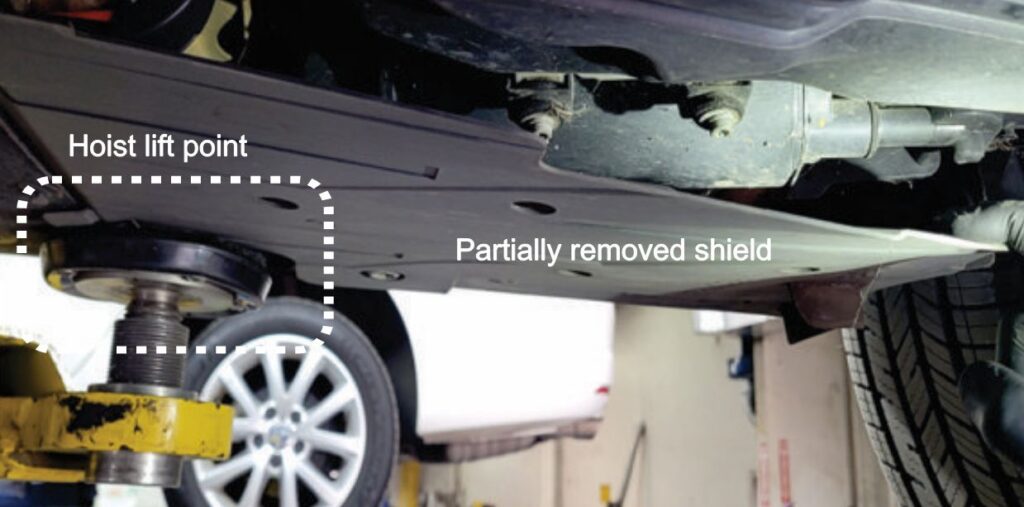
“And here is another problem” he said, pointing to a panel near the car’s lift point. “These lift pads have to be positioned correctly to lift the car by its structural frame. But, when properly positioned, the pad covers the end of the panel. Getting the panel off requires another support to hold the car long enough to reposition the hoist and remove the panel. More time wasted because of bad design!”
Other factors that affect our prices
The Labor time explains part of the difference, but there are other factors as well. Many European vehicles require specialized oils or filter designs. Others have larger oil capacities that need to be accounted for. All these add up quickly!
But Michael had even more things to share that make Euro vehicles so finicky. We were shocked to learn that “European manufacturers just don’t seem to want drivers touching anything under the hood at all. Most European vehicles DON’T EVEN HAVE DIPSTICKS to check oil level! We have to use a special scan tool that connects to the vehicle and it tells us the oil levels from the computer. Then, when the oil changes is complete, the scan tool has to reset all the service intervals.” (That scan tool is proprietary and expensive, and we have to pay not only for the tool but regular software updates to keep it current.) “On the new Audis, you have to drive the vehicle to get the temperature up, park it on a level surface to let it cool down, and only THEN can you ask the computer to read the oil.” It gets worse. “I haven’t encountered one yet, but the new BMWs won’t even let you OPEN the HOOD! It has to be opened by a code from BMW!”
We could go on, but you get the idea
Once you get a Tech talking about cars it’s hard to get them to stop, but we’ll stop our article here. You get the point… design matters in how a Technician works on your car. In the auto repair world time is money, and the longer it takes to do a task the more we have to charge. If you’re buying a Euro car then the maintenance and repair expenses, whether for oil changes or more extensive service, are something to keep in mind.
Digging Deeper
We have several articles that dig deeper into what makes our MIS more than an oil change, why you should use our ASE-Certified Technicians rather than minimally-trained Lube Jockeys, and what happens if you just decide to skip those annoying oil changes altogether. There’s even one on what we’d do for the BMW owner with the rats! We encourage you to check these or many other informative articles on the Resources page of our website.