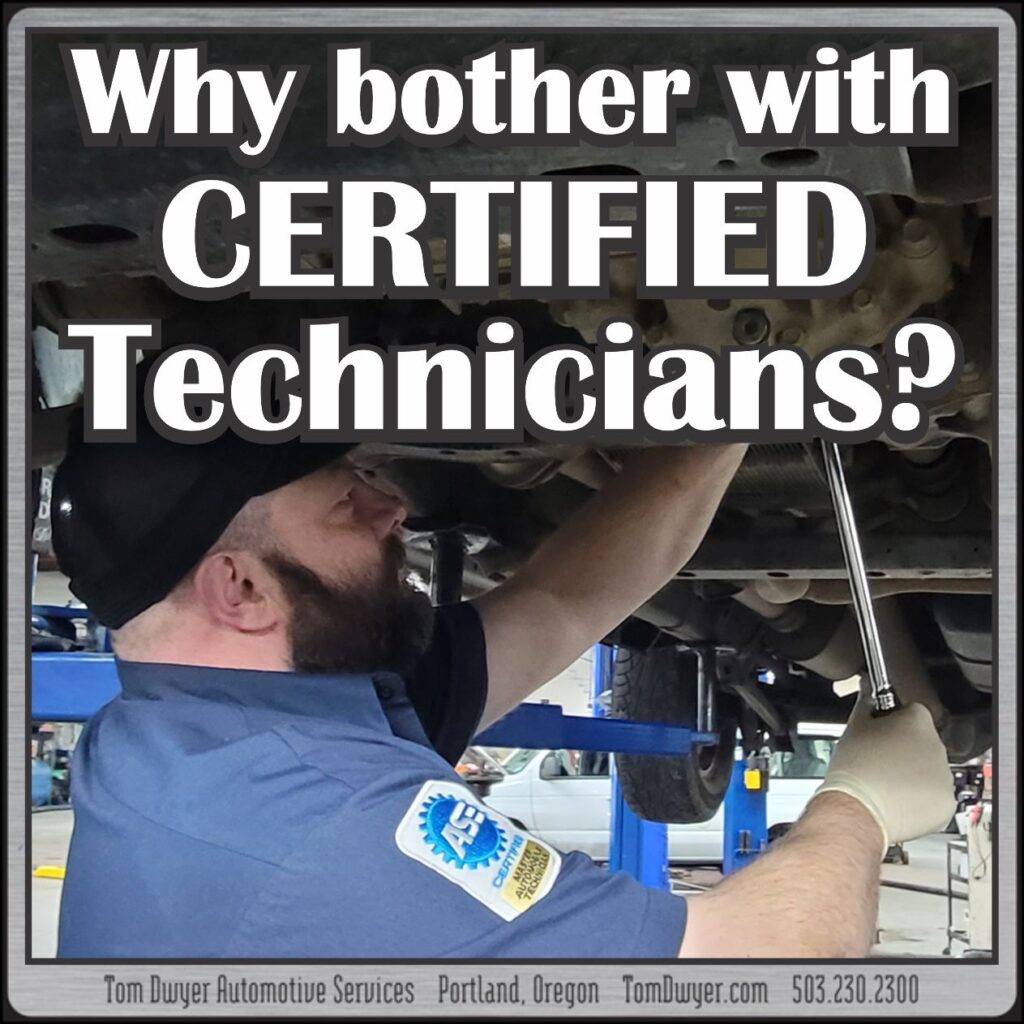
Because the quality of your work depends on the qualifications of the people doing it.
After 37 years most people are probably familiar with the two doctors on “The Simpsons”. Dr. Julius Hibbert is affable and qualified, while Dr. Nick Riviera offers cut-rate prices on questionable techniques. Yes, they’re both “doctors” (for certain definitions of the word) but the citizens of Springfield know they represent very different standards of medical care. You may not realize it, but you face a similar choice every time your vehicle is in a shop. A “Technician” of some sort will certainly work on it, but not all “Technicians” are created equal and your service will reflect the difference.
It’s not the old days anymore
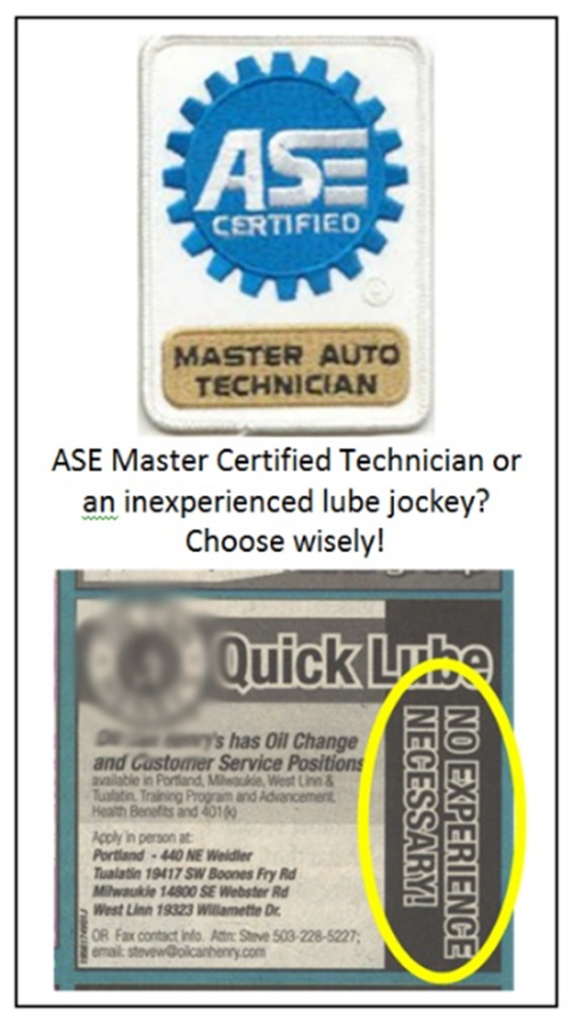
Good mechanics have always depended on their knowledge and experience but once upon a time experience came from taking apart lawnmower engines and working on cars under shade trees. No more. Today’s vehicles are complex, high-precision, rolling computer networks that demand fluency in mechanical and electrical systems as well as hydraulics and pneumatics, electronics, chemistry, software, materials, and more, Today’s Technicians must have a deep understanding of not only what’s happening but why, in a field where technology changes every year. Not even a Quicky Lube will let someone touch your vehicle without training of some kind, but just like Dr. Hibbert and Dr. Nick, the differences in training can be stark.
Dr. Hibbert and Dr. Nick go to school
So if not lawnmowers, where do new Technicians get their training? The Dr. Hibberts of the Tech World get an Associate Degree from a trade school or community college like the 2-year programs at Portland Community College or Clark College here in the Portland area. Private training also exists, like the 1-year program at Universal Technical Institute (14 locations nationwide), and there are many manufacturer-specific training courses that prepare Technicians to work in their Dealerships. These are all good training. Maybe some are better than others, but they all prepare people with the knowledge and tools they’ll need in the real world of auto repair.
The options for the Dr. Nicks of the Tech World seem to concentrate less on automotive technology. Without identifying any specific institutions, one Quicky-Lube “University” promises development in the “key areas” of “product knowledge, customer service skills, and management expertise” through “snackable” online content such as “videos, gamification and 3D animations”. At another “Academy”, $350 will buy you access to 8 online courses covering essentials like personal grooming, what to do if a fire breaks out, polite telephone techniques, and how to sell “the services offered by your center”. Maybe there’s value in these courses as well, but they’re the “Hollywood Upstairs Medical College” of Dr. Nick compared to the Johns Hopkins of Dr. Hibbert.
Out of school, into the real world
Another doctor joke… Question: What do you call someone who graduated last in their class at medical school? Answer: Doctor. The point here is that if Hibbert and Nick are both “Doctors”, how do you know which is qualified?
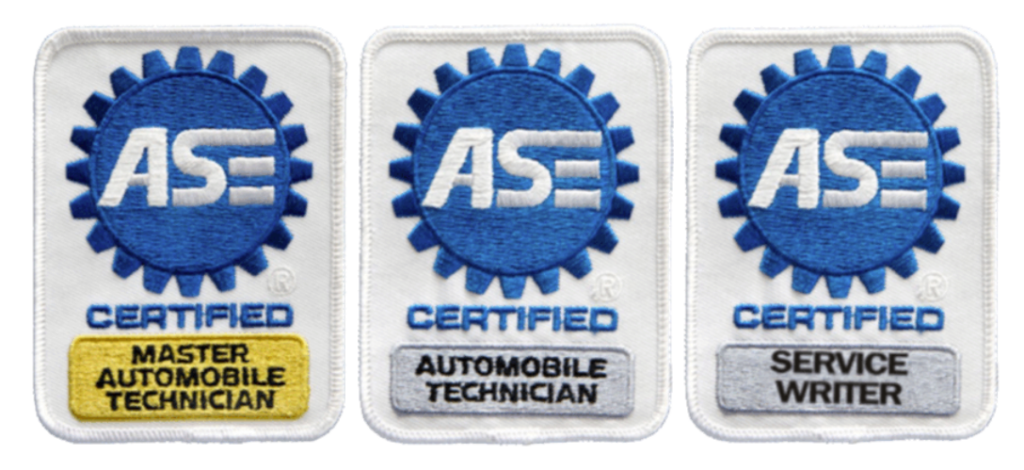
Here’s where the auto world has an advantage over medicine. There’s no way to sort doctors by their qualifications, but there is for auto Technicians… the National Institute for Automotive Service Excellence, or ASE. ASE tests and certifies Technicians across the country in a variety of areas like Engine Repair, Transmissions, HVAC, and Collision Repair. To be a Certified ASE-Technician the Tech must pass an ASE Certification test in their area and have either two years of relevant on-the-job training or one year of experience plus a two-year automotive degree. ASE-Master-Certified Technicians must pass tests in 8 areas (plus the experience requirements). Certifications are good for 5 years, and Technicians must pass a new test to be re-certified. If your Technician is wearing an ASE-Certification patch, then you’re dealing with Dr. Hibbert.
In most shops, one Master Technician oversees a couple Certified Technicians and a team of other Technicians of varying abilities and experience who do the bulk of the work. At Tom Dwyer Automotive Services, all our Technicians are Certified and half are Master-Certified.
Certifications aren’t just for Technicians
Certification isn’t just for individual Technicians, whole auto shops can be certified too. The ASE-Blue-Seal-of-Excellence program is your assurance that a shop is technically ready and staffed with professionals. To be a Blue Seal shop at least 75% of the Technicians must be ASE-Certified, and each service area of the shop must be covered by at least one ASE-Certified Tech.
To find an ASE-Blue-Seal shop near you (assuming you aren’t near Tom Dwyer) just use this Shop Locator Tool. If you’re curious, Tom Dwyer is one of only 6 Blue-Seal shops within 100 miles of Sellwood.
Experience in action
We’ve been telling you experience matters, and (all other things being equal) a Certified Technician is better than an uncertified one, but here’s ideal example of what experience looks like in the real world…
Timing chains and belts are very complex, in-depth repairs. They require removing the front of the engine (or engine covers) and replacing the critical belt or chain that coordinates the movements of pistons and valves to within thousandths of a second. There are lots of opportunities for error, and any small mistake can cause serious engine damage.
A lot of nuts and bolts go into a repair like this. For instance, the Subaru Outback has more than 50 fasteners of multiple lengths and thread types on the chain cover alone. It is critical that each specific fastener be returned to its proper place, is installed in a specific sequence, and torqued to exact specifications. It can be a tedious process to keep everything straight, and harder to have every fiddly piece there when you need it.
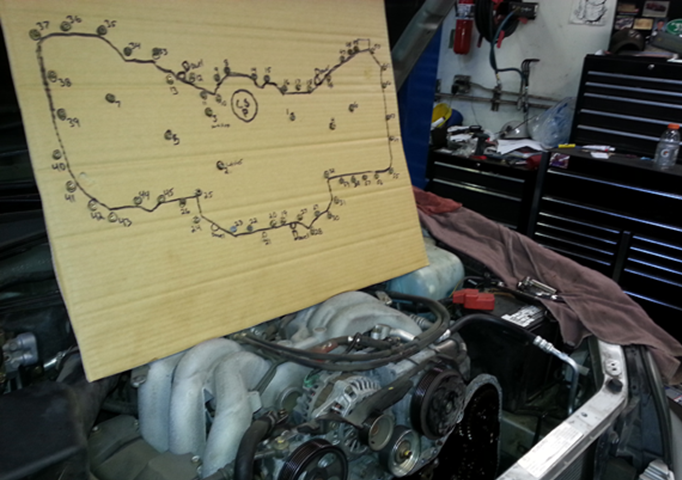
Chad D. is an ASE-Certified-Master Technician and Subaru Factory-Certified Master Technician who has been with us since 2010, and he recently tackled a timing chain job. Because he’s done so many repairs like this one, Chad has learned how to head off the problems he’s knows to expect. For jobs like this he creates a reusable schematic pattern of the timing chain cover with punched holes for each of the fasteners, and notes each hole with the installation sequence and torque specifications. He then plugs each fastener into the board as he removes it. Now instead of a box of mixed bolts he has a ready guide for reassembly and a backup to prevent error. It’s easy to set the whole board aside while he does the rest of the repair, and since each fastener is secured to the board there’s no chance of accidentally losing one. Chad’s expertise, creativity, and efficiency in developing methods like this ensures quality, accurate repairs and happy clients.
Wrapping it up
There’s a joke that being a doctor is easier than being a mechanic because doctors work on just two models that never change, while mechanics work on thousands of models that change every year. The joke going the other way is that mechanics and doctors both do surgery, but only doctors work on a patient while the engine is running.
But jokes aside, there’s a reason that auto care is so often compared to medicine. In both situations we go to trained professionals because we don’t have the technical knowledge or background to know what’s wrong ourselves. We have to trust that they understand their field, know how to diagnose problems, and how to fix them, but no one wants to have blind trust in such important fields. In medicine, the diploma on the wall is the best way to know your doctor is a doctor. In the automotive world, it’s the ASE-Certification that matters.
Digging Deeper…
ASE-Blue-Seal-of-Excellence program
National Institute for Automotive Service Excellence
Preventative Automotive Maintenance Association