
OK, some quick backstory on this. A company’s “Net Promoter Score” (NPS) is a measurement of how much their clients/customers support the business based on their reviews. We didn’t know that, so when we saw an NPS of 91 on SureCritic for Tom Dwyer Automotive we thought it was some internal marketing fluff until we went looking and found out it was real. The formula for NPS is (% promoters) – (% detractors). It’s scored on a scale of -100 to 100, with anything under 0 being bad, 0-30 being good, 30-70 great, and 70-100 being “world class”. Wow, and a deep and earnest “thank you” to all the wonderful clients who continue to support us so strongly! But we dug a little deeper and found an blog post titled “Things That Never Happened: a Net Promoter Score of 91” which again made us think our score might be, at best, a fluke. Our Outreach Advisor, Charles, outreached to the author of the post (John O’Connor at Deep Insight) to tell him about our score and John was curious enough to ask for more information. Here’s the blog post John wrote about their conversation. (And thank you, John, for taking the time to ask about this and to write such a wonderful piece. We really appreciate your interest, and especially your insights on why an American NPS might be higher than a NPS among you “dour Europeans”!)
A Net Promoter Score of +91: Fact or Fiction?
October 18, 2026, John O’Connor, Deep Insight
Net Promoter Score – is +91 actually achievable?
Some time ago I wrote a blog entitled: “Things That Never Happened: a Net Promoter Score of 91.” The basic premise of the blog that really high NPS results are simply not achievable – at least not in Europe and definitely not in complex business-to-business (B2B) environments.
Theoretically, the upper limit to a Net Promoter Score is +100. To achieve that, 100% of people must score you 9 or 10 out of 10. In reality, that’s exceedingly difficult to achieve and in our 20 years of measuring NPS, no European B2B client of ours has ever exceeded +75. In fact, the average NPS result for a European B2B company is only slightly greater than zero.
All that said, I did consider amending the title of my blog after a conversation last week with Charles Letherwood. Charles is based in Portland, Oregon, read my blog. and emailed me to say that: “we maintain a NPS of 91 (or higher) at our auto shop. Your post says this is nigh-impossible… Maybe it IS impossible for larger firms, but smaller ones can actually deliver real, personal service that gets people talking.”
The auto shop in question is Tom Dwyer Automotive Services. I checked it out. It genuinely does get very good ‘recommend’ scores from its customers.
Actually, the scores are not just very good. They are outrageously good. So good that I simply had to contact Charles to find out what made Tom Dwyer different to other auto repair companies. We had a long telephone call last week where Charles explained the ‘secret sauce’ that delivers such good NPS scores for the company. Charles has a quick and simple answer: “What makes us different? It’s our fanatical commitment to integrity.” And when you read the customer comments – which are all available online – that focus on integrity and building trust comes through loud and clear.
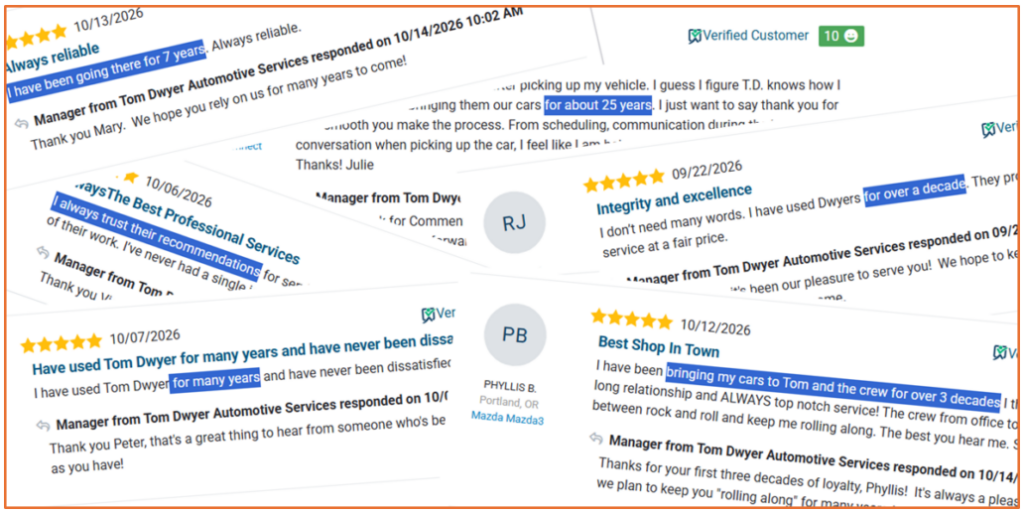
“What makes us different? It’s our fanatical commitment to integrity.”
– Charles Letherwood, Tom Dwyer Automotive Services
Customer Lifetime Value
What’s even more interesting is this: their fanatical commitment to integrity translates directly into dollars. Many of Tom Dwyer’s clients have been with them for years and, in some cases, for decades. Clients will drive long distances to have their car serviced at Tom Dwyer’s auto shop, rather than go the car repair guy just around the corner.
The value of these long-standing trusted client relationships is worth reflecting on. Customer Lifetime Value (CLV) is a concept that most of us understand intuitively but very few of us – even accountants – bother to calculate it for our own customers. We really should – particularly in the B2B world.
The 15-20 people at Tom’s auto shop aren’t just mechanics. They are relationship builders. Charles explained to me how that are encouraged to understand the customer. They are told to take the time to explain to clients what they are planning to do, and why they are doing it.
Unlike most people in the industry, they are not paid commission. They get a better than average wage and are deliberately not incentivized to maximize that value of each transaction. It’s the reason why Tom Dwyer left his previous job – see insert below. Tom’s objective is to keep the customer for life.
Tom Dwyer Automotive Services was founded in 1981 by Tom Dwyer, who established the shop in Portland, Oregon, following his dissatisfaction with the unethical practices he witnessed in the automotive industry. A defining moment for the company’s philosophy occurred when Dwyer, then an employee at another shop, refused an employer’s order to sell an unnecessary and expensive brake job to an elderly customer whose car only required a simple cleaning and adjustment.
The Power of Customer Feedback
A fanatical commitment to integrity is not the only component of Tom Dwyer’s ‘secret sauce’. You also need to be able to measure whether that fanaticism is translating into good outcomes for customers.
Tom Dwyer invested in customer feedback very early. Way back in 1998 in fact. Since that time, Tom and the team have left a pre-stamped ‘Commend Card’ in each vehicle after service. With over 23,000 responses collected to date, the team has a pretty good view of how it is performing on some of the most important aspects of automobile service.
That culture of customer feedback has shaped the company’s approach to the way it deals with customers. And that approach had paid dividends, both in terms of long client relationships and in terms of referrals. At least half of all new customers are referrals from existing clients.
Things that might have happened: a Net Promoter Score of 91
So would I change the title of my earlier blog? Well, clearly Tom Dwyer and the team have proven that NPS scores of 91 are achievable. That said, I’m planning to leave that blog stand for at least four reasons:
- The team at Tom Dwyer and the service they deliver, are quite exceptional. In fact, they are an aberration in an industry that generally strives for mediocrity. High NPS scores can only be achieved by delivering exceptional service, and by doing so consistently.
- Charles says that “smaller firms can actually deliver real, personal service that gets people talking” but he also admits that exceptional service is something that can be difficult to scale. His company could have expanded into different locations in Portland or further afield in Oregon, but Tom said no. He wanted to “do one shop and do it well.”
- There’s a third reason. Excellent service in the consumer world is different to excellent service in B2B. In general, large IT, construction or outsourcing projects are far more complex to deliver than a standard oil change or a tire replacement.
- Finally, we do need to consider that fact that Charles and Tom are based in Portland, Oregon and not in Europe. As I have mentioned many times in other blogs, Americans reward good service with much higher NPS scores that their European counterparts. It’s a culture thing – we Europeans are a dour bunch, particularly in northern Europe!
The Importance of Service Excellence
Let me finish with a final point about service. Service excellence is the cornerstone of long-term client relationships. Over time, it builds high levels of trust. That in turn drives long-term commitment and loyalty. It also creates hugely positive word of word feedback and drives new business and sales opportunities from both existing clients and from referrals. Tom Dwyer has seen that happen. Many of its clients have been with the company for decades.
If you can get the basics of service delivery right, and right first time, you will achieve high net promoter scores. If you can’t, your business could be dead in the water. That’s the topic of my next blog.
Digging Deeper
Things that never happened: a Net Promoter Score of 91, John O’Connor at Deep Insight, Aug 2023
A Net Promoter Score of +91: Fact or Fiction? John O’Connor at Deep Insight, Oct 2026
Deep Insight– “Designed for complex B2B relationships, Deep-Insight’s proven CX and EX solutions use customer and employee feedback to drive strategic decision-making.”
The ultimate guide to NPS: how the Net Promoter Score helps you [+case studies], Alyona Medelyan on Thematic, Jul 2017
Net Promoter Score (NPS): How to Measure, Calculate, and Improve, Julian Walker on SalesForce, Aug 2026