
Believe it or not, TomDwyer.com has been going about as long as the Intertubes themselves!

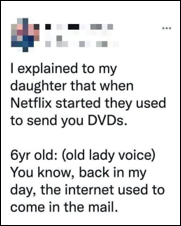
“Well, back in MY day”, said the very, very old man writing this article, “the Intertubes weren’t like what you kids have today. First, we had to connect the big box on our desk to a phone. No, not the magic godboxes you have now, “phones” were big plastic bricks that you plugged into a wall with a rope. Then we had to listen to the sound of a computer being tortured for 13 seconds just to “log up”, as the cool kids called it. When you were finally connected, or “on the line” as we said, there were only seven websites to choose from and two of those were from Tom Dwyer. None of this “streamin” stuff you softies have either; Netflix still CAME IN THE MAIL! And DON’T get me started on the picturizing! Why, in the old days, if you wanted to see a picture of a pretty lady…”
We’d tried not to let him start at all, but we’re very sure this was a good place to make him stop! The oldtimer is wrong about Tom Dwyer actually being two of the first seven websites, but he’s also not that far off. Tom has always been on the frontline of auto shop technology, for example jumping from carbon paper to the computerized shop and records management we all take for granted today. It may seem like the Internet has been around forever, and for your kids it probably has been. But in reality it’s not all that old at all and Tom Dwyer has been there since the earliest days. You’re reading this on our new site right now but let us show you a glimpse of how we got here.
The Web before 1999

The first message sent between computers used the DARPA-created ARPANET in 1969. This used paleolithic versions of the TCP/IP protocol we still use today. Tim Berners-Lee created the World Wide Web as we know it in 1989.
By 1993 the Web was beginning to use the first graphical browsers, but webpages were mostly still text files with hyperlinks and few pictures. At download speeds of 14.4kbps, if you could get it, today’s typical web picture size of 500kb would take about 4-5 minutes to load. Each. By 1994 there were between 11 and 30 million internet users, mostly in specialized professional fields. About 4.9% of the US population was online, and there were about 10,000 websites.
In 1995, Windows 95 began including Internet Explorer for free with personal computers. Now everyone who wanted to have access could have it, and content was beginning to grow. The internet was poised to explode.
Tom Dwyer first goes digital- 1999

In 1999 the Internet “as we know it” was just 4 years old, and it was the year “half of all U.S. adults” went online with roughly 150 million netizens worldwide using about 3.17 million websites. The Net was still bubbling though, not boiling. Download speeds maxxed out a little over 15kbps on a dialup modem, which was enough to download that 500k picture in about 3 minutes. The big Web companies were still new with Amazon and Yahoo founded in 1994, eBay and Craigslist in 1995, and our corporate overlord Google only starting in 1998. LinkedIn, Skype, Facebook, YouTube, Twitter and all the rest were still only a twinkle in some cybernetic eye.
It only took one website to change the Internet from what it was to what it is today… TOMDWYER.COM. (No, really! Before, it was the internet WITHOUT TomDwyer. Ever since, it’s been the internet WITH TomDwyer! No hyperbole here!) Thanks to the WayBack Machine we can see what that first homepage looked like… and that really is Tom in the picture!
AI tells us that “Auto repair websites in 1999 were simple, text-heavy directory pages or basic digital storefronts… While local Portland shops used the web primarily for contact information, major parts retailers and subscription databases laid the groundwork for today’s comprehensive DIY guides… Local auto shops, like those around the Pacific Highway corridor, treated the internet as an online Yellow Pages directory to list a phone number, address, and list of services.” You can definitely see some of those points in our site, but already Tom was pushing the envelope. Ours included appointments, features, tips, outside links, and feedback. Check out those prices though… the “Inspection for Purchase” was $100; today it’s our Comprehensive Inspection and it’s about $180!
In our archaeological digging into 1999 we found several other sites that would give you a cringy walk down memory lane.
Web Design Exhibitions, Web Design Museum
Surfing the web like it’s 1999, Retro Tech Dreams
How Teens Spent Time On The Web In 1999, Brian McCullough on InternetHistoryPodcast.com
What Apple, Google, and Amazon’s websites looked like in 1999, Brittany Levine Beckman on Mashable, Aug 2023
What the Internet Was Like in 1999, Richard MacManus on CyberCultural.com, Sep 2025
Tom Dwyer The Next Generation- 2002
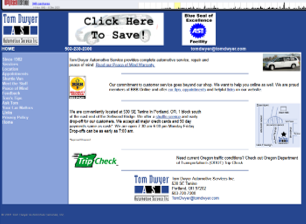
Just 3 years later the Internet was growing exponentially. Obviously not BECAUSE of TomDwyer, but it took off just as TomDwyer.com started… just sayin. There were 587 million users, roughly 9.4% of the world’s population. There were 38.7million sites, and download speeds were around 400kbps with the early broadband speeds. Still not fast, but that 500kb picture would now only take 10 seconds to download.
And once again, Tom Dwyer was in the vanguard of web presence, already moving away from the simple “yellow pages ad” format, bringing in corporate colors, extended menus, and backgrounds. This website would be our cybernetic front door for the next nine years.
Tom Dwyer Goes Big- 2011
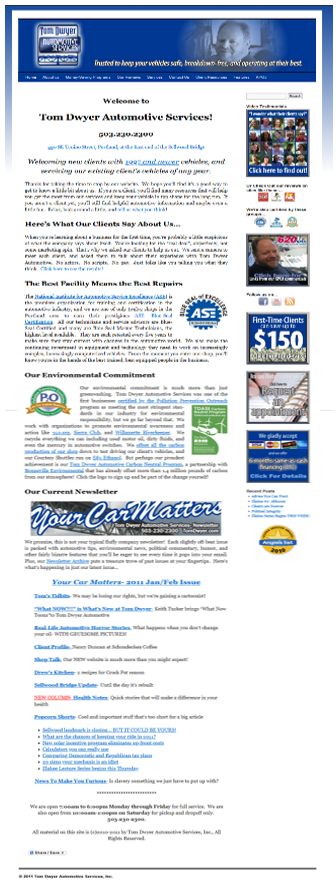
By 2011 the Intertubes were beginning to look a little more like what we expect today. In nine years, global users had grown from about half a billion to about 2.4 billion, more than a 400% increase. 555 million websites were available, with 300 million going live in just 2011. Much of this growth came from the increasing download speeds, which by 2011 had jumped from measuring in “kbps”, or thousand-bits-per-second, to “Mbps” or million-bits-per-second. The new broadband technology made it possible to download that 500kb file in less than half a second.
And Tom Dwyer overhauled the site once again to integrate these new capabilities. The faster downloads meant that we could use pictures more liberally and we did, using images as buttons for our most important features. This also allowed us to use video, pictures, and extended graphics within the site whenever we thought they were necessary.
By 2011 websites were (usually) expected to be much more than a landing page, and this revamp let us start to live up to those expectations. We added our monthly newsletter content to the homepage, and began storing all the posts to create a searchable archive of information. Yes, car information, but hundreds of other articles as well on every other subject imaginable.
Google wasn’t a factor when our first two websites were designed, but it was when our 2011 design hit. SEO optimization was critical to get the algorithms to find us, so there were menu items, pages, and post content specifically written to attract the web crawlers. Posts like “What car brands do we service?”, followed by a long string of auto manufacturers, were written for the new bots to read. But we still concentrated on making things interesting to our human priorities.
This website, with frequent tweaks, would serve us well for the next 15 years but time and the Intertubes would eventually catch up with us.
Tom Dwyer Leaps Into The Future- 2026
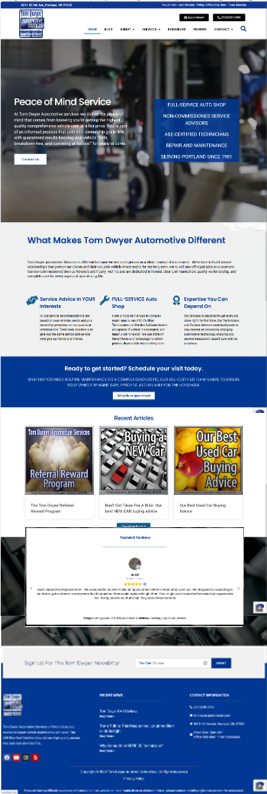
Which brings us to today, and our newest website design. The Net has grown quite a bit since 1999; now there’s 6 billion users rocking 1.5 billion websites, a 4,000-fold increase in people and a 400-fold increase in things for them to do. And they’re doing it faster every day. Fixed broadband speed in the US now averages 308Mbps, which will download our sample 500k file in just over 1/100th of a second. Looking at it another way, you could download an entire movie 35 times in the same time it took to download one picture in 1999!
We’ve designed the website to serve two main audiences. First, it’s a tool for potential clients to get to know us, so all the stuff about services and reviews are right up front. But it’s also there for our existing clients to use as a go-to resource in their auto-ownership lives. We know it’s not always easy to process everything we’re saying as you’re picking up your car, so we have detailed articles on tires, brakes, sadfjkg;oidfgh
When it comes to web design we are wonderful mechanics, so we worked with Chris Moore at Moore Web Exposure to make the magic happen. He did a spectacular job of creating the site and migrating the 2461 posts and 9032 media items to fill it.
The emphasis on resources is intentional. Just as part of our 2011 site was tailored to SEO, in 2026 it has to appeal to AI and that’s not as simple as including keywords. Today, experts say AI is not looking for links that may be useful for your search so much as it’s looking for information it can distill into its own stand-alone answer. There’s good and bad in that; you’re provided an answer instead of having to figure one out by yourself, but on the other hand you’re provided an answer instead of having to figure one out by yourself. Either way we hope our vast library will a thirst trap for our digital overlords and a valuable, useful resource to the humans we still serve.
As proud as we are of our new site, it’s still a work in progress. It currently uses AI pictures throughout but we’ll be replacing those with pics of our own shop, our own people, and our own work, as soon as possible. We held Dwyer Picture Day last week, so expect to see a Meet Our Team section. Every month we’ll be adding to our Resources through the Tom Dwyer Newsletter that will be posted on the page. And there’s more to come! Our last website lasted almost 15 years and we’ll be expecting the same, maybe even more, from our current incarnation. Please join us on the journey!
Finally, WE WANT TO HEAR FROM YOU! Yes, we overhauled the website, but nothing is ever set in stone. Please drop us a line (best is charles@TomDwyer.com, but you can also call us at 503-230-2300 or send snailmail to 8211 SE 6th Ave, PDX, 97202) and tell us what YOU think. Tell us if there’s something missing or something we’ve just gone overboard on. Is there something specific you’d like to see? WE WANNA KNOW! In the meantime, thank you for coming by our new place, and we hope to see you back soon!