
Popcorn Shorts is about the kind of things we think are really interesting, but don’t really need a large article to explain them. From the sublime to the ridiculous, check in here for crunchy bits of info you’ll love to munch.

“I Can’t Get Out Of This Dream”- The Roche Authority
We can go on all day about what makes Tom Dwyer Automotive different (call and talk to Charles if you don’t believe us!) but if you had to pick just one thing it would be our people. All of them are pros in their fields, but all of them have lives outside of Dwyer that make them so interesting. One of them, Nick R., the guy who makes sure the money you spend with us is well-spent and not frittered away, is also a songwriter and performer who’s been doing some incredible stuff lately. Please give us the privilege of introducing you to “I Can’t Get Out Of This Dream” which Nick wrote, sang, and art-directed the accompanying AI video. Then check out “Know Forever”, “Lalania”, or “Baby I Think I’m Fallin For You”. And if you understandably want more from Nick you don’t have to come to Tom to get it, Nick’s available as The Roche Authority on Amazon, Spotify, or wherever you go for music.
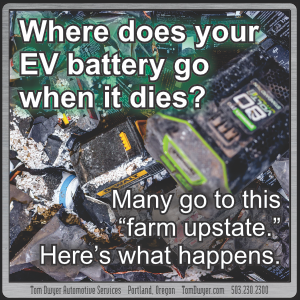
Where Does Your EV Battery Go When It Dies
(Washington Post, Oct 2025)— “When an EV battery dies somewhere in North America, there’s a good chance it’ll wind up here, among the sand and shrubs of the desert, to be reborn. This is the home of the biggest lithium-ion battery recycling plant in the United States. It’s where run-down batteries from every rechargeable device you can imagine are stacked, sorted and stored in neat rows in a 32-acre graveyard beneath the pale blue sky. Redwood Materials, the company that runs this plant, will eventually break them down into their components and extract valuable metals such as lithium, nickel and cobalt, which can be remade into new batteries.” Here’s how it all works!

Better Living Thru Better Coffee
(Washington Post, Apr 2026)- From a scientific point of view, a cup of coffee is a conundrum. More than a thousand molecules contribute to the flavor, influenced by the beans, the level of roasting, the grinding technique and, finally, brewing. The result can be an inconsistent cup that is unpredictable in taste and quality — too acidic, burnt-tasting or weak… Scientists at the University of Oregon took a device called a potentiostat that generates a varying voltage, stuck its electrodes into a cup of coffee and measured the current flowing through coffee samples. The samples were made with the same beans, roasted to different levels and prepared with an identical brewing process. They found that the larger the charge passed through the coffee, the stronger the brew was — stronger coffee was more electrically conductive. The darker roasted coffee was less conductive at the same strength, in part because of the buildup of molecules like caffeine on the electrodes…”
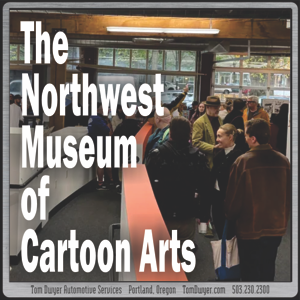
Northwest Museum of Cartoon Arts
The Northwest Museum of Cartoon Arts is OPEN NOW at 322 NW 8th Ave! Check out their website here, or catch up with the Willamette Week article below…
(Willamette Week, Nov 2025) “The museum’s debut exhibition is called The Pacific Northwest in Comics and features 5,000 square feet for visitors to peruse… Next up is a spotlight exhibit on Helioscope, the largest cartoonist studio in the Pacific Northwest, featuring work by 15 of its artists… Past that is a writer’s room, which is a place to relax and read. Some of the most challenging work in the museum is in the back, with two exhibits on the Gaza War: one on Crucial Comix’s new book Cartoonists for Palestine and the other on Portlander Joe Sacco’s comic War on Gaza… NWMOCA plans to be a teaching museum with a slate of workshops and book talks already scheduled for December. NWMOCA is close to other downtown arts institutions such as the Oregon Jewish Museum and Center for Holocaust Education, the Pacific Northwest College of Art, and Blue Sky Gallery…”