
 The political conventions are in the bag, and now America is faced with a choice between the two most reviled and unpopular candidates ever to run for President. In November we’ll have to make the best choice we can so we might as well start now,
  and the place to start may not be with the distortions of political campaigns. It may be to look inside ourselves. Understanding how we make decisions and realizing the biases we each bring to the table will help us all make the best decision possible in this election, and there’s an awful lot hanging on the quality of America’s decision this year.
This month’s Book Spotlight shines on five books and one article that, we hope, will be useful to us all in the coming months…
We’re All Biased, but That Doesn’t Keep Us from Making Valid Decisions, article by Emily Rosenzweig in Scientific American, Jul 2016
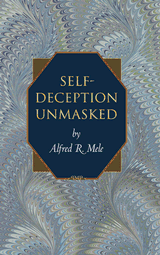 Self-Deception Unmasked by Alfred Mele
Self-deception raises complex questions about the nature of belief and the structure of the human mind. In this book, Alfred Mele addresses four of the most critical of these questions: What is it to deceive oneself? How do we deceive ourselves? Why do we deceive ourselves? Is self-deception really possible?
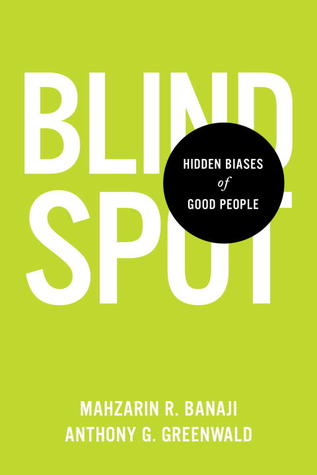 Blindspot: Hidden Biases of Good People by Mahzarin Banaji
“Blindspot” a metaphor for the portion of the mind that houses hidden biases. Writing with simplicity and verve, Banaji and Greenwald question the extent to which our perceptions of social groups-without our awareness or conscious control-shape our likes and dislikes and our judgments about people’s character, abilities, and potential.
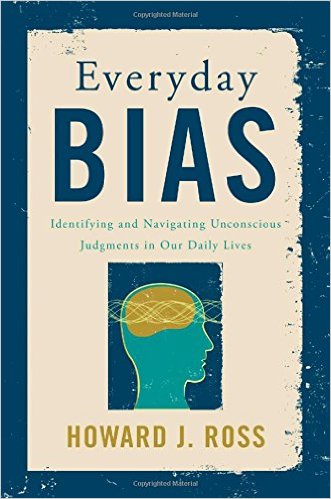 Everyday Bias- Identifying and Navigating Unconscious Judgments in Our Daily Lives, by Howard Ross
If you are human, you are biased. From this fundamental truth, diversity expert Howard Ross explores the biases we each carry within us. Most people do not see themselves as biased towards people of different races or different genders. And yet in virtually every area of modern life disparities remain. Even in corporate America, which has for the most part embraced the idea of diversity as a mainstream idea, patterns of disparity remain rampant. Why? Breakthroughs in the cognitive and neurosciences give some idea why our results seem inconsistent with our intentions. Bias is natural to the human mind, a survival mechanism that is fundamental to our identity. And overwhelmingly it is unconscious.
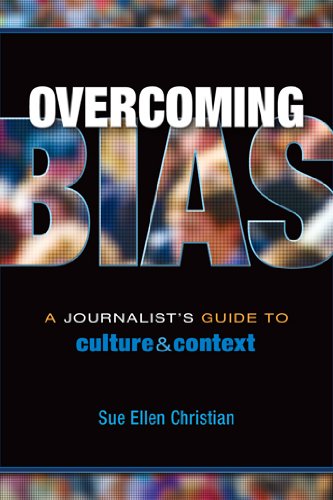 Overcoming Bias: A Journalist’s Guide to Culture & Context by Sue Ellen Christian
Journalists go out of their way to avoid purposeful bias in the news. But there is a more pervasive set of internal biases and flaws in thinking that can lead to unintentional inaccuracies and distortions in news coverage. This engaging book offers a fresh take on reporting without bias, targeting the way that we categorize people, filter information and default to rehearsed ways of thinking. Included throughout are stories and on-target advice from reporters and editors, providing real-world voices and experiences. This advice and guidance is coupled with practical exercises that give readers the chance to apply what they learn.
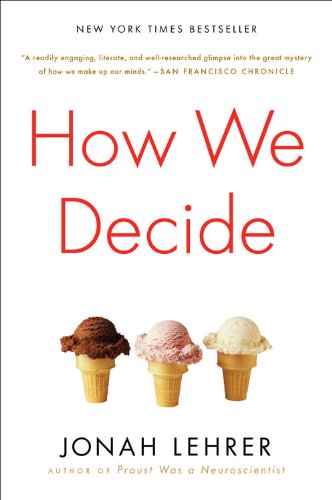 How We Decide by Jonah Lehrer
Our best decisions are a finely tuned blend of both feeling and reason – and the precise mix depends on the situation. When buying a house, for example, it’s best to let our unconscious mull over the many variables. But when we’re picking a stock, intuition often leads us astray. The trick is to determine when to lean on which part of the brain, and to do this, we need to think harder (and smarter) about how we think. Jonah Lehrer arms us with the tools we need, drawing on cutting-edge research by Daniel Kahneman, Colin Camerer, and others, as well as the real-world experiences of a wide range of deciders – from airplane pilots and hedge fund investors to serial killers and poker players.