 Warren Buffett famously said “There IS a class war, and MY class is winning”. The Occupy movement put that Class War into the streets, drawing clear battle lines between the top 1% and the rest of us. This month, “Your Car Matters” sent one of our intrepid reporters to Occupy Portland to get a firsthand look into the trenches of the Class War and talk to some of the people fighting it…
(Charles Letherwood, filed from Occupied Portland, November 1, 2011)- On September 17, a large group of people entered New York’s Zuccotti Park to “occupy” Wall Street. Without leaders, they decided to speak to the media through consensus. Without specific demands, they issued “A Modest Call To Action” outlining the reasons they were there, and inviting others to join them. Even without a clear list of objec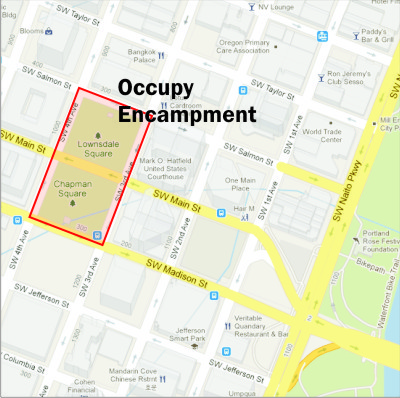 tives enough people heard and understood their message that similar Occupations quickly sprouted in cities around the country and around the world. Not surprisingly, Occupy Portland was one of earliest on the list and continues to maintain one of the most active groups. Their occupation of Lownsdale and Chapman parks (downtown on either side of the elk statue on Main Street) is now entering its fourth week.
The mainstream media largely ignored Occupy before settling on describing it as Fox News’ worst nightmare… left-wing radical hippies a hairsbreadth away from violence. (This despite the fact that the Occupiers have always emphasized that the gathering is a NON-VIOLENT, CONSTITUTIONALLY PROTECTED petitioning of the government for redress of grievances, and their actions so far have overwhelmingly borne this out). They’ve been derided as unwashed, unemployed, uneducated, unrealistic, and more. OK, “unwashed” may be a pretty hard one to argue… living in a park for weeks can have that effect. But “unemployed” and “uneducated”? Those are the very root of the Occupier’s complaints! And as for “unrealistic”; in a free society it’s not unrealistic to expect government to be responsive to its people! So if the media picture of Occupy is inaccurate, what does the truth look like?
I’ve been to Occupy several times since it started, and it’s been different every time. The hundreds of people able to camp in the park are only a small slice of the thousands who keep showing up for the various Occupy marches. While these sometimes-demonstrators are from every age and every walk of life, it’s true that the long-term campers largely seem to be hippies of one flavor or another. One of the folks I talked with made a conscious connection to the protests of the 1960’s- “We made a difference then. The US wouldn’t have been out of Vietnam nearly as soon if the people weren’t in the streets shouting. These are different issues, but I hope we can make a difference again.” Many campers fit the stereotype of young hippie wannabes; teenagers who have adopted the tribal styles and bongos of their forebears and are in the streets because it’s cool. But these young people are also there because they face serious issues of unemployment and student debt. There’s also a contingent of homeless people, enjoying the free food and a place to sleep without being hassled.
But stopping there leaves a distorted understanding of the movement, and does a disservice to the message and the people. It glosses over the soldier who told the crowd that he had been ordered not to attend any of the Occupy rallies. “I’ve been a soldier for 14 years” he said, his voice shaking a little. “This is the first time I ever disobeyed an order. But I had to be here.” It doesn’t address the young woman I talked with whose mother was fired from her 30-year position without warning, given the severance package intended for the 10-year employees, and told to “go away”. It ignores the man who stood to tell about having his life’s savings wiped out, or the single mom who was working while she went to school but had nothing to look forward to but debt and unemployment. To show how easy it is to find people like these who break the media mold, I sat down and talked with three semi-random people during my latest trip to the camp. All were educated, none were on drugs, and all said they had bathed recently.
Carrie Medina, who had been camping in the park for about a week, was working at the Media Tent when I met her. Because her “day job” is in computers and can be done remotely, she has been free to spend up to 20 hours a day volunteering on Occupy.  “That’s been pretty typical for everyone volunteering on the project”, she says. Communication, especially Facebook and Twitter, has been critically important both in organizing Occupy and matching a befuddled media with the fuzzy message coming from the camps. “We deal with all kinds of media reps here. Reporters who want the superficial story just hang around the fringes, but when someone wants to go deeper, they come into the camp and we connect them with people who can speak intelligently about our issues.” Asked what brought her into the streets, she answered “I’m pretty lucky. I do have a home, and its quite nice compared with my tent. But finding out that JP Morgan, Chase, Citigroup, Bank of America, and Allied Financial took bailout money and then started illegally foreclosing on mortgage holders, I thought that was just disgusting. It’s just not right.” Carrie was also concerned with the higher education financing system. “I have student debt of my own. The education system is being sold to us as an investment that brings a return, but the reality is that many of us with $30,000 to $70,000 in debt can only find jobs paying $12 an hour. You can’t repay debts that big on an income like that.” Carrie’s final remarks summed up the issues of the Occupiers nicely… “I think the system as a whole is broken. We’re systematizing greed, and enough people are starting to wake up that you get these displays of frustration. You see it expressed in different ways because we have so many people with their individual causes, but the underlying movement is that the economic system is disadvantaging the 99%, and we need real working solutions for change.”
Near the Communications tent is the Food Service area, where volunteers keep a steady stream of donated food going for the campers. A.O. Noor Mohamed (I’ll call him “Noor” in this article) recognized me from the 350.org “Moving Planet” event that Tom Dwyer  Automotive helped sponsor in August. Noor is one of many supporters who is unable to spend the night (“my constitution does not allow it”) but who comes the Camp every once in a while. His particular issue is homelessness, and he has been dividing his time between Occupy and the Right 2 Dream encampment on Burnside. Noor’s solution to homelessness would involve people who live in on about a hundred acreas as a community, putting their own sweat equity into the project. They would work to grow the food, raise the animals (“Other than pork, because I am a Muslim and I don’t encourage eating of pork!”), and build the resources they’d need… a form of urban subsistence farming. Noor’s feelings on housing and payment go back to his childhood. “When I lived in Kenya, our family owned some property. My mother’s midwife, the lady who delivered us, her only son died and she was left with her grandson, who was six or seven. We let them live on the property free. She offered to pay, but I told her that when your grandson is old enough to earn money, THEN you pay us rent. I think that is what is missing in this country, and it’s missing big time.”
I found Wade Varner attempting to manage the chaos of the Engineering tent. Just like Carrie’s Communication tent and every other function of Occupy, Engineering is a volunteer-run operation that relies on donations. “People just walk up and donate hundreds of dollars worth of stuff, and we’re grateful for every bit of it,” he said. Wade’s a disabled Vietnam Veteran who used to repair nuclear reactors for Navy subs, but like so many Vets he’s currently homeless. I sat down to talk with Wade amid stacks of generators, batteries, cabling, and other esoteric supplies.
Wade has been with Occupy since the first General Assembly meeting, and he thinks it is long overdue. “I’ve wondered for years when the kids were going to get out and hit the streets. I mean we’re getting screwed at every different angle here; what’s wrong with these guys?” He believes fairness begins with a fair tax system. “Everyone should be taxed equally. The only reason the poor don’t pay taxes is that they don’t make enough money. Try raising a family of 4 on $18,000 and you’ll understand. But the guy who made the most money off the Fall made $8.7 billion dollars because he bet against everything. He paid 15% on that. That’s your retirement fund, your friend’s house, and more.” Wade lays much of the credit for Occupy Portland at the door of our Mayor. “Thank God we have a good mayor in Sam Adams. He told the police to back off and let us do our thing because it’s our Constitutional right, just like it was for the Tea Party”. Asked where he thinks the movement will go, Wade seems optimistic. “This whole thing is about equality, and making sure America doesn’t look like Bombay. Look, I’m a small businessman myself. I own Carnivore Café and Catering and Tie-Dye Café and Catering. I LIKE making money. But I give away a third of my money, and there’s hundreds of people right out there that think the same way. I’m finally glad to see a few passionate people standing up.”
Wade’s optimism may be justified, as these passionate people seem to be generating wider support. An October 20 TIME poll surveyed people familiar with Occupy Wall Street, and found that sweeping majorities agreed with the movement’s grievance that the gap between rich and poor has grown too large, including 85% of households making under $50,000 per year and 65% of those making more than $100,000 annually. Almost three-quarters of households earning up to $100,000 backed the contention that the rich should pay more taxes. Even 52% of households making more than $100,000 per year agreed. Seventy-three percent support a surtax on millionaires to help close the federal deficit.
The original Occupy protest in Wall Street could have easily degenerated into a New York version of “The Battle of Seattle”, the episode when protests of the 1999 WTO meetings turned violent. Although the Seattle protestors may have had legitimate criticisms, whatever points they had were immediately lost in the glare of the riots. But the leaderless organization of Occupy learned from that, and as the movement spread across the country the emphasis on non-violent, peaceful protest became a mantra. The accusations of disruptive behavior were met with codes-of-conduct among the Occupy encampments. In Portland, with a clash between OccupyPDX and the Portland Marathon looming, the Occupiers decided to not just get out of the way but to help the Marathoners stage their event.
The protestors know their chant “The Whole World Is Watching”, shouted at police to keep them aware of their own actions, applies to Occupy and their message as well. They know that they have been portrayed as nutcases, but the more the media tells their story the harder it will be to maintain that image. They know that the fewer distractions they offer the clearer and louder that message will be. And it’s a simple and powerful message. As Wade Varner said, “It’s all about fairness and equality for all of us, which is guaranteed by the Constitution. All the Tea Party folks talk about the Constitution? Well, this IS the Constitution. Freedom of speech. Freedom to assemble. This is it.”